


National Geographic 1994 April
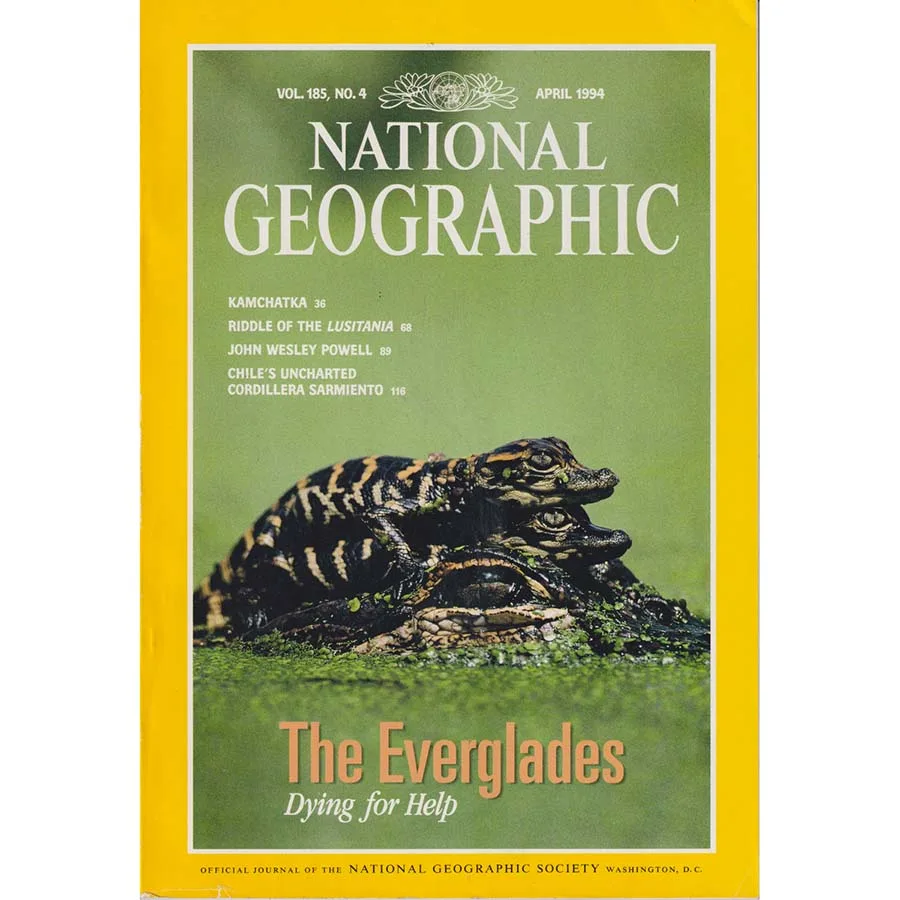
Publisher: National Geographic
Format: Paperback
ISBN: none
Welcome to National Geographic, April 1994 (Vol. 185, No. 4) — a gloriously 90s issue that turns up in its famous yellow frame like a dependable teacher who’s about to show you something fascinating, slightly alarming, and beautifully photographed… and then politely expect you to care about it afterwards.
The cover is deceptively simple: a soft green background, and two small alligators stacked like they’re auditioning for a nature documentary called Sibling Rivalry: Swamp Edition. Beneath them, the headline lands with the quiet heaviness Nat Geo does so well: “The Everglades — Dying for Help.” Which is simultaneously a plea, a warning, and the sort of phrase you can’t really shrug off and go back to your snacks. The Everglades isn’t “having a bit of a rough patch.” It is dying for help. April 1994 was already doing environmental doom with impeccable typography.
Inside, the magazine does that classic National Geographic trick: it lures you in with wonder, then gently locks the door behind you until you’ve learned something.
The main feature on The Everglades is the big, wet, complex story of a place that looks like “just a swamp” right up until you realise it’s a living machine — water, grass, birds, fish, reptiles, and human engineering all tangled together. It’s an ecosystem that doesn’t shout; it seeps. And Nat Geo, in full earnest 90s mode, lays out the damage, the stakes, and the uncomfortable fact that nature can be ruined not only by malice, but by years of “seems fine” decisions. You’ll finish the article with a new respect for slow-moving water and the faint suspicion that civilisation might not be as clever as it thinks.
But because this is National Geographic, you don’t just get one worry. You get a whole curated selection of worries and wonders, neatly arranged like a world tour for your brain:
-
Kamchatka — a region that sounds like a spell and behaves like a nature flex. Volcanoes, wilderness, “you probably shouldn’t be here” energy.
-
Riddle of the Lusitania — maritime mystery, history, and the irresistible pull of unsolved questions. It’s the kind of story that makes you say “surely we’d know by now” and then learn, once again, that the ocean keeps secrets.
-
John Wesley Powell — a reminder that exploration used to involve a lot more moustaches and a lot fewer safety briefings.
-
Chile’s uncharted Cordillera Sarmiento — pure Nat Geo adventure material: remote, rugged, dramatic landscapes that make your own weekend plans feel extremely soft.
Condition: Good, which is exactly right for a magazine like this: sturdy, readable, ready to be pored over, left open on the table, and used as proof that you once spent an evening thinking seriously about wetlands and shipwrecks like a responsible adult. Expect some honest age, but plenty of life — the kind of copy that has done its time on a coffee table and is now ready for a second career making someone quietly obsessed with water management.
If you want an issue that combines swamp drama, volcano country, historical intrigue, and mountains that look like they were designed to intimidate, April 1994 is a classic. Sold by Crappy Old Books, naturally — because the world’s finest second-hand guilt-and-wonder journalism has to live somewhere.
Keep browsing: See more National Geographic books Other books by National Geographic
